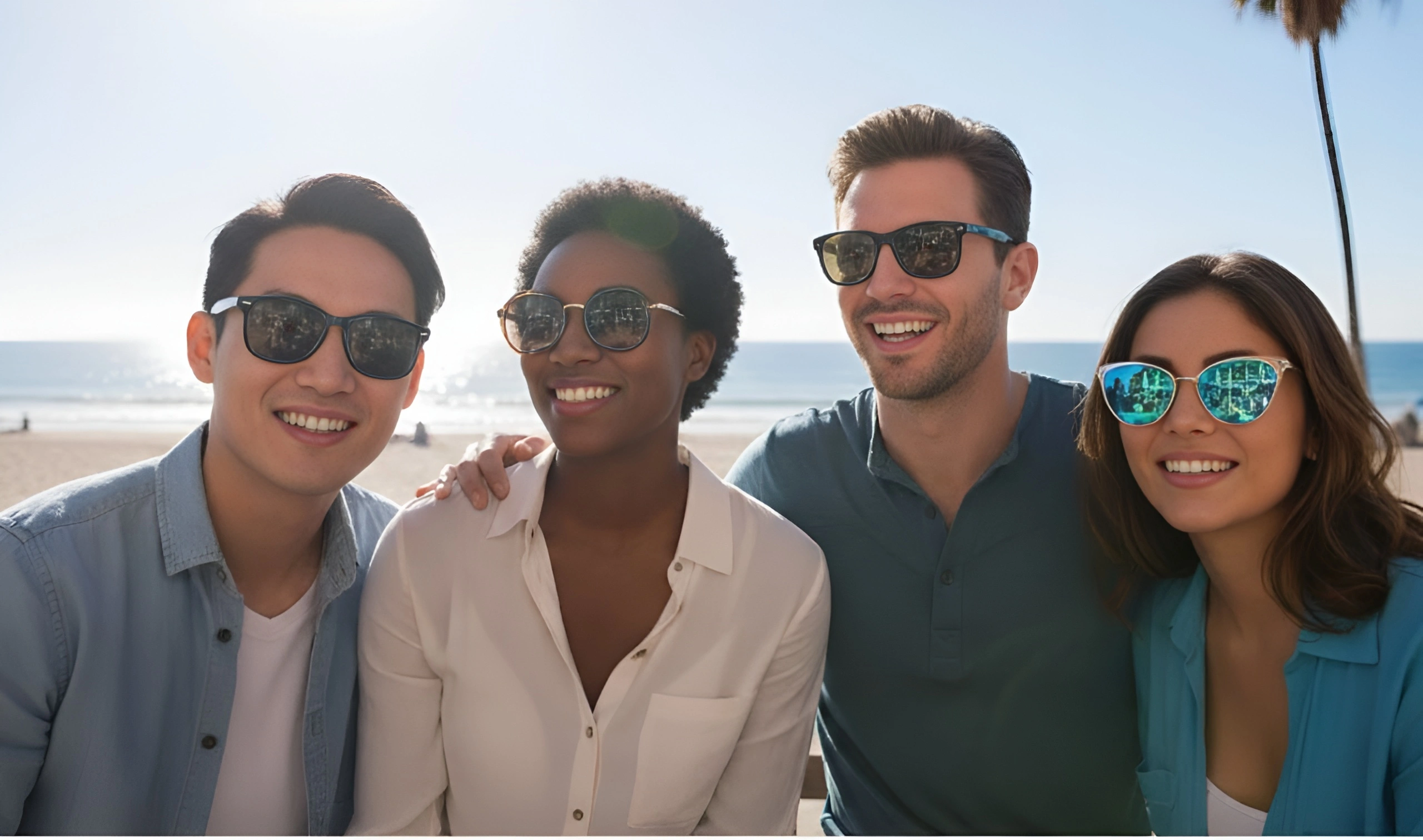
UV protection for eyes is just as vital as wearing sunscreen, yet many people skip it when heading outdoors. While we often associate sunglasses with summer fashion or reducing glare while driving, their primary function is medicinal.
Think of your sunglasses as a “shield” for your ocular health; without them, the delicate structures of your eyes are left vulnerable to invisible, high-energy radiation that can cause permanent damage over time.
UV Protection for Eyes: Why It Matters Year-Round
It is a common misconception that you only need to protect your eyes when the sun is scorching. In reality, ultraviolet (UV) radiation is present every day, regardless of the temperature or cloud cover.
- The Invisible Threat: UVA rays can penetrate deep into the eye, while the cornea and lens primarily absorb UVB rays.
- Reflective Surfaces: UV rays don’t just come from above. They reflect off surfaces like water, sand, pavement, and especially snow, which can reflect up to 80% of UV light.
- The Cloud Myth: Clouds may block visible light, but they do very little to filter out harmful UV rays. This is why “winter sun” can be just as damaging as summer sun.
What Are the Long-Term Risks of UV Exposure?
If your eyes are repeatedly exposed to the sun without a barrier, the damage accumulates. Much like a skin tan is a sign of cellular stress, certain eye conditions are direct results of “sun-stressed” tissues.
- Cataracts: Over time, UV exposure can cause the proteins in your eye’s lens to clump, leading to cataracts that blur your vision.
- Macular Degeneration: Long-term exposure to UVA rays is linked to damage in the retina, specifically the macula, which is responsible for your central vision.
- Photokeratitis: Often called “sunburn of the eye” or snow blindness, this is a painful, acute condition caused by a massive burst of UV exposure.
- Pterygium: Also known as “Surfer’s Eye,” this is a non-cancerous fleshy growth that can eventually cover the cornea and distort your sight.
How to Choose the Right Pair of Sunglasses
When you are browsing for a new pair of shades, the price tag or the designer logo is less important than the sticker on the lens. To ensure you are getting actual long-term eye health tips in the form of a product, look for these specific features.
- The UV400 Label: This is the gold standard. It means the lenses block 99% to 100% of all UV rays up to 400 nanometers.
- Tint vs Protection: A common mistake is thinking darker lenses are safer. In fact, a dark lens without a UV filter is dangerous; it causes your pupil to dilate, letting more unfiltered radiation into the eye.
- Polarized Lenses vs UV Protection: It is important to remember that polarization only reduces glare from flat surfaces. While great for driving or fishing, polarization itself does not block UV rays unless the lens is also UV-rated.
Are Children More Vulnerable to UV Damage?
Children are at a significantly higher risk of solar damage than adults. Their lifestyle and biological development make them prime candidates for early-onset ocular stress.
- Transparent Lenses: A child’s lens is much clearer than an adult’s, meaning it cannot filter out UV rays as effectively before they reach the retina.
- Outdoor Time: Kids generally spend more time outdoors than adults, yet they are the least likely to be wearing protective eyewear.
- Lifetime Accumulation: Experts believe that a large portion of a person’s lifetime UV exposure occurs before the age of 18. Starting the habit of wearing sunglasses early is a critical preventative measure.
Conclusion
Your vision is one of your most precious senses, and protecting it doesn’t have to be complicated.
By choosing a pair of UV400-rated sunglasses and wearing them consistently-even on gray days-you are taking a proactive step toward preventing cataracts and other degenerative conditions. Make UV protection for eyes a non-negotiable part of your daily routine, just like grabbing your keys or your phone.
Frequently Asked Questions
Can my eyes actually get sunburned?
Yes. This is known as photokeratitis. It usually causes redness, a gritty feeling like sand in the eyes, and extreme sensitivity to light. While it usually heals in a few days, it is a sign of significant UV damage.
Do expensive sunglasses protect better than cheap ones?
Not necessarily. A $10 pair of sunglasses with a “UV400” or “100% UV Protection” sticker provides the same level of UV filtration as a $500 designer pair. The higher price usually accounts for frame durability, brand name, or lens clarity.
If my contact lenses have UV protection, do I still need sunglasses?
Yes. UV-blocking contacts only protect the small area they cover (the cornea and lens). They do not protect the white of the eye (the conjunctiva) or the sensitive skin of the eyelids, which are prone to skin cancer.